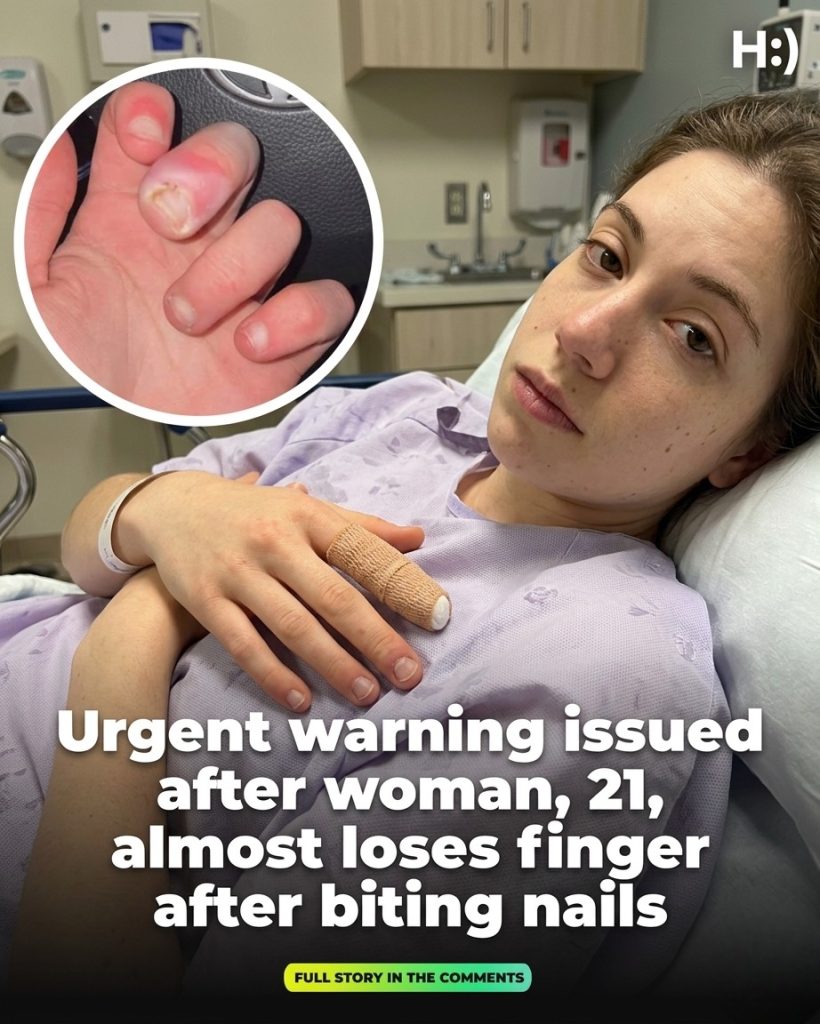
A 21-year-old woman has issued a serious warning about a habit many people consider harmless after she nearly lost her finger due to a severe infection caused by nail biting. The case involves Gabby Swierzewski, a young restaurant manager who had been biting her nails since childhood, a habit medically known as onychophagia. Although she had experienced minor issues in the past such as sore fingers or small hangnails, she never expected the habit to escalate into a medical emergency. In February, what began as a small tear of skin near her nail quickly developed into something far more dangerous, eventually requiring urgent hospital treatment and raising fears that she could lose part of her finger. Her experience has since become a cautionary example of how even seemingly minor habits can lead to serious health consequences when they introduce infection into vulnerable areas of the body.
According to her account, the issue began on February 6 when she noticed a painful hangnail, something she initially assumed would resolve on its own as it often had in the past. However, within a short period of time, the situation rapidly worsened. The finger became increasingly swollen, red, and intensely painful, signaling that an infection was developing beneath the skin. Despite trying to continue her daily routine and even working through her shifts, the condition escalated to the point where the finger changed color and became severely inflamed. Eventually, antibiotics were prescribed, but they did not resolve the infection, and her symptoms continued to worsen. This progression highlights how quickly a small break in the skin around the nail can become a gateway for bacteria, especially when exposed repeatedly through habits like nail biting, which introduce microorganisms from the mouth into open wounds.
As her condition deteriorated, Gabby was eventually rushed to the emergency room, where doctors determined that the infection had become serious enough to require immediate intervention. Medical staff performed procedures to drain abscesses that had formed within the finger, indicating that the infection had progressed beyond a superficial level. However, even after initial treatment, swelling and pain persisted, prompting a referral to a specialist. According to her recollection, the specialist described the case as one of the most severe they had seen in someone her age, emphasizing the unusual intensity of the infection. At this stage, doctors were concerned not only about the possibility of losing the nail but also about the more extreme risk of partial or complete finger amputation if the infection continued to spread or reached deeper tissues such as bone or tendon structures. This level of severity demonstrates how untreated or resistant infections in small areas like the fingertip can escalate into major medical emergencies requiring surgical intervention.
On February 19, Gabby underwent an urgent surgical procedure known as irrigation and debridement, which involved making an incision in the finger to thoroughly clean out infected tissue and remove any remaining abscess material. The procedure aimed to prevent further spread of bacteria and reduce internal pressure caused by swelling. Tissue samples were collected and sent for laboratory analysis to determine whether the infection had spread deeper into the body, including the possibility of bone involvement, which would have significantly increased the risk of long-term damage or amputation. Blood tests were also conducted to assess the severity of the infection systemically. Fortunately, over the following weeks, her condition began to improve, and by early March, doctors confirmed that no additional surgery would be necessary. The infection had been brought under control, and the risk of losing her finger had been avoided, although recovery still required careful monitoring and ongoing healing of the affected tissue.
