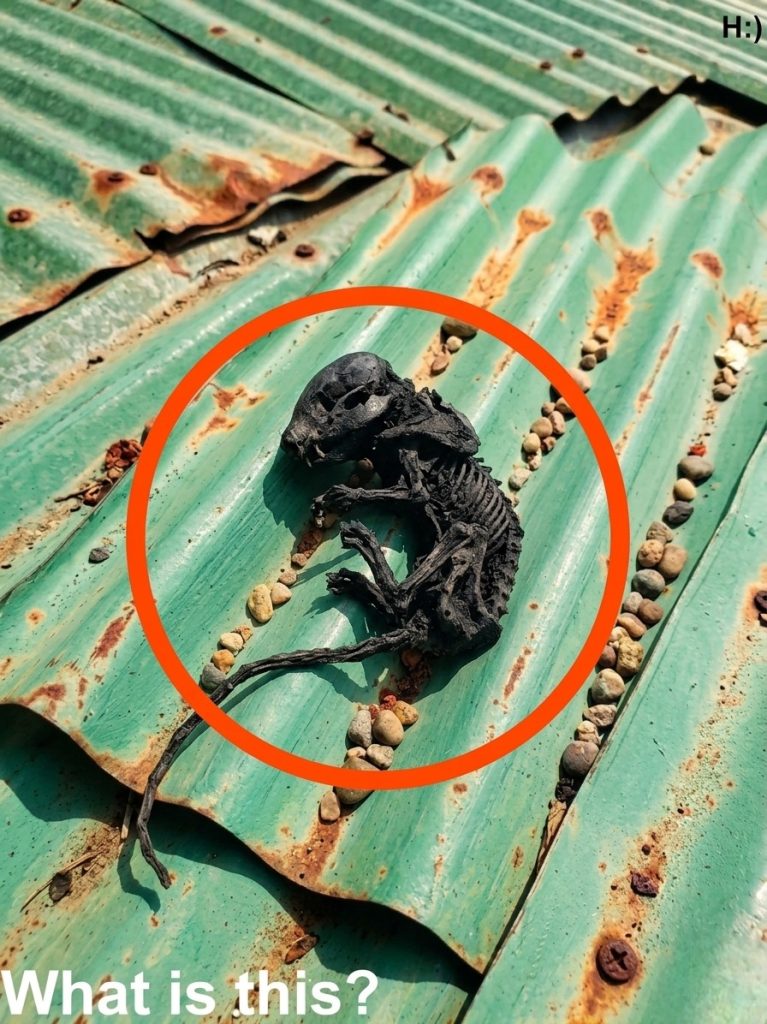
I was just trying to fix a leaky roof on an ordinary afternoon, the kind of task you postpone for weeks until the drip finally becomes impossible to ignore. The ladder felt slightly unstable against the siding, the metal warm from the sun, and every step upward came with that familiar hesitation between caution and annoyance. I remember thinking how small the problem seemed from the ground—just a stain on the ceiling, just a bit of water after rain—but up close everything always looks more complicated. The shingles were older than I liked to admit, brittle in places, soft in others, and scattered across them were the quiet signs of years of weather doing what weather always does. I had barely started inspecting the source of the leak when something near the edge of the roof caught my attention. At first it was nothing more than a distortion in shape, a kind of uneven shadow where everything else was predictable lines and textures. But the longer I looked, the more it felt wrong in a way I couldn’t immediately explain. It didn’t belong there—not in color, not in form, not in the way it interrupted the pattern of dust and debris. My mind tried to rationalize it as trash caught in the wind or maybe a clump of old insulation pushed out by time, but something about it resisted easy explanation. It sat too still. Too deliberate. As if it had chosen that exact place to stop existing.
The closer I leaned, the more my imagination began doing what it always does when it’s given too little information and too much silence. The shape seemed to change depending on how I looked at it, like it was refusing to be understood from a single angle. My stomach tightened in that slow, uneasy way that happens before logic catches up with instinct. There’s a specific kind of fear that doesn’t arrive loudly—it builds quietly, almost politely, until you realize your breathing has changed. I remember gripping the edge of the roof a little harder than necessary, as if physical pressure could stabilize the thoughts forming in my head. From a distance, it had looked like a twisted object, but up close it suggested something far more unsettling: texture where there shouldn’t be texture, curvature where there shouldn’t be life. For a brief, irrational moment, I considered stepping back down the ladder and pretending I had never seen it at all. That would have been easier. But curiosity, especially the uncomfortable kind, rarely allows retreat. Instead, I leaned in further, squinting, trying to force clarity out of uncertainty. The wind shifted slightly, and the object moved just enough to collapse all the worst possibilities my mind had been rehearsing. What I had mistaken for something unnatural revealed itself, slowly and without drama, as something painfully ordinary—yet no less disturbing for what it represented.
When recognition finally replaced speculation, the fear didn’t vanish; it transformed. It settled into something heavier, quieter, almost reflective. It wasn’t a threat, not a mystery, not a hidden danger waiting to unfold. It was simply the remains of something small that had once been alive, carried by chance and time into a place where no one would notice it until now. The roof suddenly felt less like a surface I was repairing and more like a silent archive of everything that passes unnoticed above daily life. Birds, insects, wind-blown fragments of the world below—all of it eventually ends up somewhere no one thinks to look. I found myself staring longer than I expected to, not out of curiosity anymore, but out of a strange sense of witnessing something I wasn’t meant to interrupt. There’s a moment in situations like that when the mind stops trying to categorize and simply observes. The discomfort doesn’t come from what you see, but from the realization of how quickly your assumptions tried to turn ambiguity into something alarming. I climbed down from the roof a little slower than I had gone up, not because there was any danger left, but because my thoughts felt heavier than my body. The leak still needed fixing, the tools still waited on the ground, but for a few minutes I just stood there, letting the ordinary world reassert itself around what had briefly felt like something else entirely.
Back on the ground, the house looked unchanged, indifferent to the small internal shift that had just occurred above it. That contrast—the stability of everything else versus the intensity of my reaction—stayed with me longer than the moment itself. It made me think about how easily the mind constructs meaning out of incomplete images. From a distance, we rarely see things as they are; we see what our expectations allow us to see. A shadow becomes a shape, a shape becomes a story, and the story becomes something we react to emotionally before we ever confirm whether it is real. Standing there with the ladder still trembling slightly from my descent, I realized how much of fear is built not on reality but on interpretation. The roof, after all, had only contained debris and time, not danger or mystery. Yet for those few minutes, it had held my full attention as if it were the center of something significant. That realization carried a strange kind of humility with it, a reminder that perception is always partial and often misleading. Even now, thinking back, I can reconstruct the exact moment when imagination overtook observation, when uncertainty briefly became certainty in the wrong direction. It didn’t take anything dramatic to correct it—just distance, light, and patience. But in the moment itself, it felt like standing on the edge of a story I didn’t understand.
I eventually returned to the roof to finish the repair, though the experience had changed the way I moved. I was more deliberate, less distracted, more aware of how easily attention can drift into interpretation. The leak turned out to be exactly what I had suspected all along: a loose section of flashing, nothing more. Fixing it required no insight, only patience and the simple repetition of actions I had done before. And yet the memory of what I had seen lingered at the edges of thought, not as fear, but as a kind of reminder. It made the ordinary feel slightly more layered, as if every surface might contain something that could be misread if viewed from the wrong angle. I thought about how many times in life similar moments must occur without recognition—small misunderstandings between perception and reality that never get corrected because no one looks closely enough. The roof beneath my hands was just wood, nails, and aging materials, but for a brief interval it had been something else entirely in my mind. That transformation, I realized, was more significant than the object itself. The world hadn’t changed; my interpretation of it had. And that difference, subtle as it was, felt like the real discovery of the day.
By the time I finished and climbed down for the final time, the afternoon had softened into a quieter version of itself. The light was lower, less harsh, and the earlier tension had dissolved into something almost reflective. I washed my hands at the outdoor sink, watching small bits of dust and debris swirl away, thinking about how quickly moments of unease become stories we tell ourselves later with more distance than emotion. What had felt alarming in the moment now seemed almost fragile in its simplicity. There was no mystery left, only the memory of having briefly believed there was one. And yet, that belief had felt real enough to alter my heartbeat, my focus, my sense of space. It struck me how easily the mind can construct entire narratives out of incomplete information, and how often those narratives feel more compelling than the truth once it finally arrives. The roof was fixed. The leak was gone. Nothing dramatic had happened at all. But something had shifted anyway—not in the house, but in the way I understood the thin line between perception and reality. I went back inside as the light faded, leaving the roof behind as just a roof again, though I knew I would occasionally remember it differently than it had actually been.Even later, when the day had fully settled into evening and everything outside had gone still, the memory of that moment lingered with a strange clarity. Not as fear anymore, and not even as surprise, but as a reminder of how quickly the mind tries to complete unfinished pictures. I kept returning to the realization that what unsettled me most wasn’t what I found, but what I almost convinced myself I had found. The difference between the two was thin, almost invisible, yet it shaped the entire experience. It made me more aware of how often we move through the world filling in gaps without noticing, assuming intention where there is only randomness, assuming meaning where there is only chance. The roof incident became less about what was there and more about what I brought to it—my expectations, my imagination, my readiness to interpret silence as something significant. In the end, it wasn’t a story about discovery in the physical sense, but about recognition in a quieter one: the understanding that not everything strange is meaningful, and not everything meaningful is strange. Sometimes, it is just what it is, waiting for us to look again with calmer eyes.
