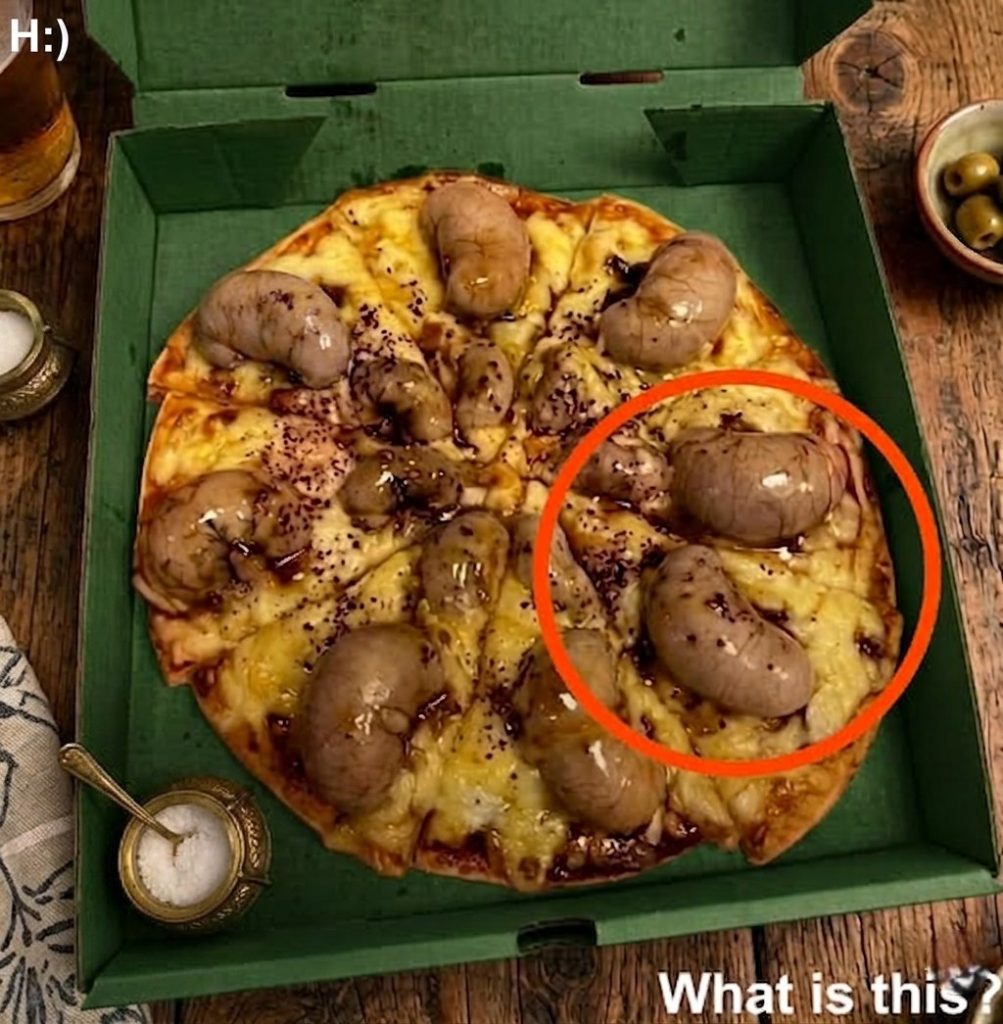
For a few long seconds I just stared, my appetite wrestling with pure suspicion, as if I were no longer just looking at a pizza but at something that had quietly shifted categories in my mind from “food” to “unknown object.” The “blisters” looked like strange organs trapped under the cheese, smooth and inflated, catching the light in a way that made them seem almost deliberately formed rather than naturally occurring. It was the kind of visual detail that your brain latches onto and refuses to let go of—tiny domes of pale gold and slightly browned cheese rising unevenly across the surface, each one suggesting a hidden interior pressure that I couldn’t immediately explain. I remember thinking that if I had walked into the room without knowing what it was, I might not have identified it as pizza at all in the first second or two. That realization alone was enough to create a strange discomfort, because so much of how we trust food is based on immediate recognition. If something looks familiar, we relax. If it doesn’t, even slightly, we begin to question everything about it. I leaned closer, narrowing my eyes as if distance was the problem, as if changing perspective would somehow restore order to what I was seeing. But instead of clarifying things, the closer inspection only made the texture more complex—the glossy surface of melted cheese, the uneven air pockets, the faint bubbling frozen mid-collapse like small geological events preserved in cheese. My imagination started filling in gaps faster than my reasoning could correct them, producing half-formed ideas about contamination, failed recipes, or something going wrong in the cooking process that no one had noticed until now.
As the seconds stretched, my thoughts drifted into that uncomfortable space where curiosity and anxiety overlap, where you are both trying to solve a puzzle and slightly afraid of what the answer might be. I found myself constructing explanations that escalated in seriousness without any real evidence guiding them. At first, I assumed it might just be overcooked cheese, then under that thought came the idea of poor ingredient quality, then something about storage, and then—completely irrationally—some vague fear of contamination that had no foundation beyond the fact that I didn’t immediately understand what I was seeing. The mind, when it encounters something visually unfamiliar in an everyday context, tends to behave like an overactive detective that refuses to accept “it’s probably nothing” as a valid conclusion. I noticed how quickly my sense of trust in the object eroded simply because I couldn’t categorize it instantly. It wasn’t that the pizza had changed—it was that my expectations had been disrupted. I even tilted the box slightly, hoping that gravity or angle would “correct” the illusion, as if perspective alone could resolve uncertainty. Instead, the domes shifted subtly in appearance, becoming even more pronounced under the new angle, which only deepened the feeling that something unusual was happening, even though nothing actually was. In that moment, I wasn’t really evaluating food anymore; I was negotiating with my own perception.
Eventually, curiosity began to outweigh hesitation, not because fear disappeared, but because the need to resolve ambiguity became stronger than the discomfort it caused. I reached for my phone almost instinctively, like most people do now when reality feels uncertain—outsourcing interpretation to the collective intelligence of the internet. I typed in awkward, overly specific phrases that reflected my confusion more than accuracy, scrolling through results that quickly revealed I was not the first person to experience this exact moment of doubt. There were photos, comments, and discussions from people who had paused mid-meal for the same reason, all describing the same “weird bubbles” or “blisters” on cheese. And slowly, through repetition and comparison, a simpler explanation emerged: these were just air and moisture pockets formed during baking, a completely normal result of heat interacting with fat and protein in melted cheese. What I had interpreted as strange or potentially concerning was actually just physics and food chemistry operating exactly as expected. The trapped air expands when heated, steam forms underneath the cheese layer, and as the surface sets unevenly, it creates those dome-like structures. There was no hidden meaning, no mistake, no contamination—just predictable behavior that looked unfamiliar when isolated from explanation. It struck me how often knowledge doesn’t change what we see, but changes what we think what we see means.
Once that understanding settled in, the entire emotional tone of the moment shifted almost immediately. What had felt slightly unsettling a few minutes earlier now looked almost interesting, even beautiful in a very ordinary, overlooked way. I found myself noticing details I hadn’t appreciated before—the variation in browning, the delicate tension in the cheese surface, the subtle gradients of heat exposure that created different textures across the pizza. It was as if the explanation didn’t just remove fear but unlocked a different kind of attention. I realized that I had been interpreting the visual irregularities as “errors,” when in reality they were just outcomes of a natural process. That shift in perspective felt surprisingly large for something so small, because it reflected a broader pattern in how people interpret the unknown. When we lack context, we default to assumption; when we gain context, we often reframe the same object completely. The pizza hadn’t changed at all, but my relationship to it had transformed from suspicion to understanding in a matter of seconds. I actually laughed a little, not because anything was funny in a traditional sense, but because of how quickly my mind had constructed an entire narrative around something so ordinary. It was a quiet reminder that perception is not passive—it is actively built, moment by moment, out of expectation and interpretation.
By the time I picked up a slice, the tension had fully dissolved, replaced by a kind of reflective amusement. The first bite grounded everything again in physical reality—warmth, salt, texture, familiarity. There was nothing unusual about it at all, which in itself felt slightly absurd given how much mental energy I had just spent analyzing its surface. Eating it while remembering my earlier suspicion created a contrast that made the experience feel almost educational, like I had briefly stepped outside my normal way of interpreting everyday objects and then returned with a clearer awareness of how easily that interpretation can be distorted. I started thinking about how many other moments in life follow a similar pattern—how often people misread situations simply because they appear unfamiliar at first glance, how quickly the brain jumps from “I don’t understand this” to “something might be wrong.” That gap between perception and explanation felt significant, not just in the context of food, but in how people process uncertainty in general. Most things that initially seem strange usually have simple explanations once context arrives, but the mind doesn’t wait for that explanation—it fills the silence immediately with assumptions that feel real in the absence of facts.
In the end, what stayed with me wasn’t the pizza itself, but the realization of how easily ordinary reality can feel unfamiliar when stripped of explanation for even a short moment. Those cheese bubbles became a small example of something much larger: the way human perception is constantly negotiating between what is seen and what is understood. Without context, even simple things can feel strange; with context, even strange things become ordinary again. I finished the slice thinking about how often I probably misinterpret things in daily life without ever realizing it, simply because I don’t pause long enough for understanding to catch up with observation. And yet, that small moment of confusion also felt valuable, because it exposed how quickly the mind constructs meaning where none is needed. The pizza was just pizza the entire time—nothing more, nothing less—but my experience of it moved through suspicion, curiosity, discovery, and finally acceptance, all within a few minutes. It reminded me that perception is not a fixed truth but a process, constantly shaped by knowledge, expectation, and the quiet space between not knowing and understanding.
