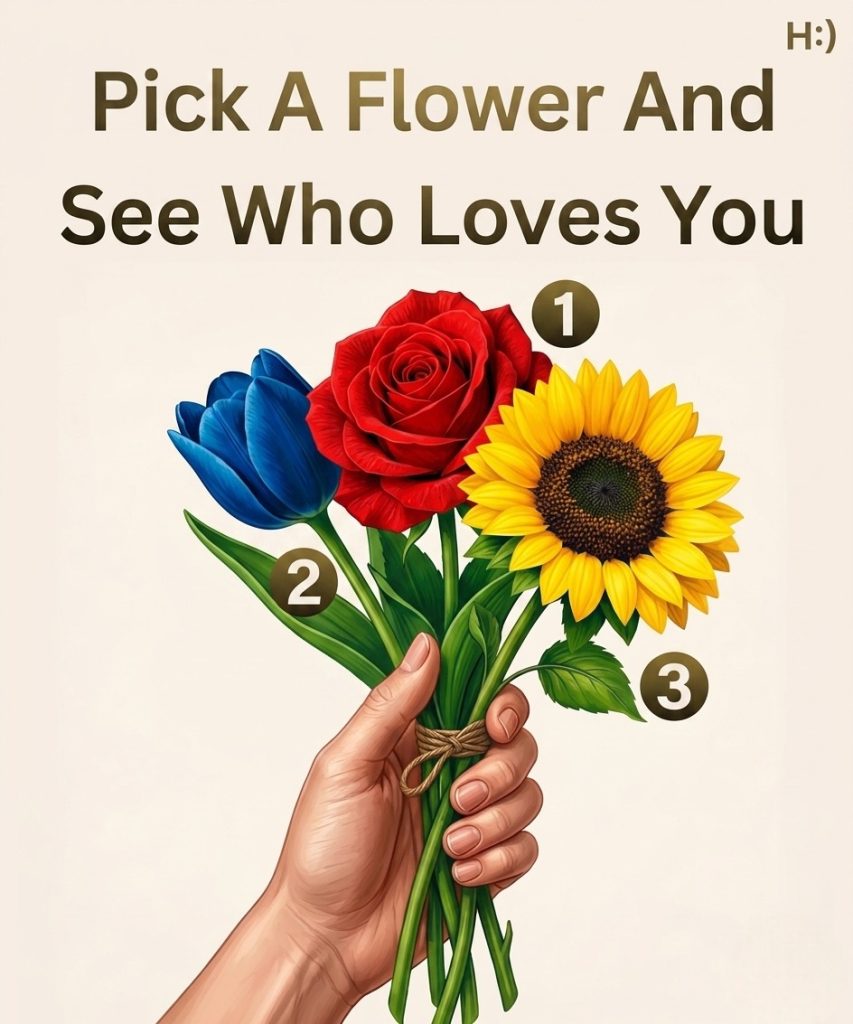
What makes symbolic personality quizzes like choosing a flower so compelling is not that they reveal objective truths about who we are, but that they give structure to something humans constantly struggle with: interpreting themselves through meaning. In everyday life, identity is not something we can easily observe in full. We don’t see ourselves the way others do, and we rarely have a complete, consistent picture of how we behave across different situations. Instead, we rely on fragments—memories, emotions, reactions, and the feedback we receive from others. When an image asks us to choose between symbolic options like flowers, it simplifies this complexity into a single moment of intuition. That moment feels small, but psychologically it is built from layers of experience: our past relationships, our current emotional state, our cultural associations, and even subtle mood shifts we are not fully aware of. A person who selects a red rose might not consciously be thinking about passion or romance, but their brain may still be responding to years of conditioning where red is linked with intensity, love, and emotional depth. In the same way, someone who chooses a sunflower may be drawn not just to its appearance, but to the feelings of warmth, stability, and openness that it symbolizes in art, media, and everyday language. These associations happen faster than rational thought, which is why the choice feels instinctive rather than calculated. The result is a fascinating blend of perception and meaning-making, where a simple visual preference becomes a symbolic reflection of internal emotional patterns, whether or not we actively recognize them.
Once a choice is made, the mind naturally begins to interpret it, and this is where the experience becomes even more interesting. Humans have a strong tendency toward narrative thinking—we don’t just observe events, we explain them, connect them, and turn them into stories. So when someone selects a flower and is told what that choice “means,” the brain often tries to integrate that interpretation into its self-image. If the result says the red rose represents deep, passionate love, the person may start scanning their memory for moments that align with that idea. They might think about relationships where they felt intensity, or people they care about deeply, or even times they wished for stronger emotional connection. If the result suggests the sunflower reflects loyalty and warmth, they may recall moments where they supported others or felt emotionally dependable. This process is not necessarily about belief in the accuracy of the quiz, but about coherence—the human mind prefers explanations that feel consistent, even if they are symbolic rather than scientific. In psychological terms, this is closely related to how we interpret personality tests or horoscopes: not as strict definitions, but as frameworks for reflection. The meaning doesn’t come from the flower itself, but from how we relate it to our own experiences. In that sense, the interpretation becomes a mirror shaped by suggestion, where people see aspects of themselves that already exist, but were not previously articulated in that form.
Another important layer of this phenomenon is emotional projection. When people engage with symbolic choices, they often project current emotional needs onto the options in front of them. This means that the flower someone chooses may reflect less of a fixed personality trait and more of a temporary emotional condition. For example, someone experiencing emotional distance or uncertainty in relationships might gravitate toward symbols that represent clarity, simplicity, or quiet affection, because those ideas feel comforting or desirable in that moment. On the other hand, someone feeling energized, expressive, or romantically engaged might be more drawn to intense and vivid symbols like a red rose, because it aligns with their heightened emotional state. Even subtle mood differences—stress, excitement, loneliness, or contentment—can influence how we interpret abstract visuals. This is because emotional cognition and visual perception are deeply interconnected. The brain does not process images in isolation; it filters them through emotional context. That is why the same flower image can feel entirely different depending on who is viewing it and when they are viewing it. This fluidity highlights an important truth about human psychology: personality is not static. It shifts depending on environment, relationships, and internal emotional rhythms. These symbolic quizzes, while simple, unintentionally capture that fluidity by allowing people to map their current emotional state onto a neutral visual choice.
At the same time, these interpretations gain power because of their social dimension. When people share results—whether online or in conversation—they are not only reflecting inwardly but also seeking external validation. If someone is told that their flower choice indicates they are loved deeply or admired secretly, that message can trigger curiosity about how others perceive them. Humans are inherently social beings, and much of our self-understanding is shaped by interaction. We often learn who we are by observing how others respond to us, especially in emotionally significant contexts like friendship, romance, or family relationships. Symbolic quizzes tap into this social curiosity by suggesting hidden narratives about connection—someone secretly admires you, someone values your loyalty, someone is emotionally drawn to your presence. Even when we consciously recognize that such claims are generalized, they still activate emotional reflection because they relate to universal human desires: to be seen, to be valued, and to be understood. In this way, the flower becomes more than a personal symbol; it becomes a social metaphor, inviting us to imagine our place in the emotional landscape of others. That imagined social reflection is often what makes these experiences memorable, even if they are brief or playful
It is also worth considering how cultural symbolism shapes these interpretations. Flowers themselves are not emotionally neutral objects; across history and culture, they have been assigned meaning through art, literature, religion, and tradition. The red rose, for example, has long been associated with romantic love in Western culture, appearing in poetry, mythology, and celebrations like Valentine’s Day. The sunflower is often linked with positivity, growth, and resilience because of its physical behavior of turning toward the sun, which has been metaphorically interpreted as loyalty or optimism. The blue tulip, being less common, carries associations of rarity, uniqueness, and emotional depth simply because it stands out from more familiar floral imagery. These cultural associations become embedded in collective memory, meaning that when people make a choice in a quiz, they are not responding to the flower alone—they are responding to centuries of symbolic meaning layered onto that image. This is why such quizzes feel surprisingly accurate to many people: they are not random; they are built on shared cultural understanding. Even if the interpretation is generalized, it resonates because it reflects familiar symbolic language that already exists in our minds. In essence, the quiz does not create meaning from nothing—it draws on meaning that culture has already placed there, then reassigns it back to the individual in a personalized form.
Ultimately, what makes these symbolic flower-choice reflections so engaging is not their ability to define us, but their ability to invite introspection. They create a space where people can pause and consider emotions that are often left unexamined in daily life. In a world that moves quickly and demands constant attention, moments of reflection—even playful ones—can feel surprisingly grounding. Whether someone identifies strongly with the idea of passionate love, quiet affection, or loyal warmth, the deeper value lies in the act of thinking about those concepts at all. It encourages awareness of how we relate to love, how we perceive ourselves in connection to others, and how we interpret emotional experiences through symbolism. At their best, these exercises do not tell us who we are; they gently prompt us to ask questions about who we feel we are in that moment. And because human identity is always evolving, those questions remain open-ended. A flower choice made today might reflect one emotional state, while the same person choosing again months later might select something entirely different. That change is not inconsistency—it is humanity. In that sense, the simplicity of choosing a flower becomes a reminder that identity is not a fixed label, but a continuous process of interpretation, feeling, and self-discovery shaped by time, experience, and emotion.
