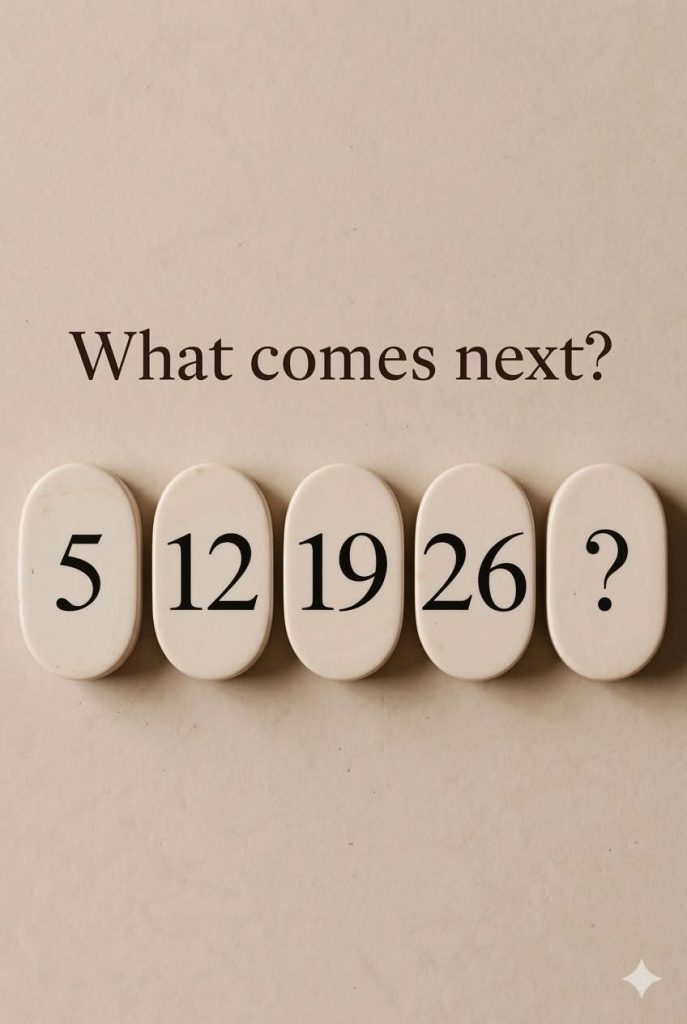
Number puzzles are a fun way to train logical thinking. In this problem, we are given a sequence: 5, 12, 19, 26, and we are asked to find the next number.
To solve this, we need to look for a pattern. A common method is to check the difference between each pair of numbers.
Let’s calculate:
- 12 minus 5 equals 7
- 19 minus 12 equals 7
- 26 minus 19 equals 7
We can clearly see that each number increases by 7. This means the sequence follows a simple rule: add 7 each time.
This type of sequence is called an arithmetic sequence, where the difference between consecutive numbers is always the same.
Now, to find the next number, we just continue the pattern:
26 + 7 = 33
So, the missing number is 33.
Why is this important? Recognizing patterns like this helps improve problem-solving skills. Many math problems, puzzles, and even real-life situations depend on finding regular patterns.
For example, understanding sequences is useful in finance (like calculating payments), in programming, and in science.
This puzzle is simple, but it teaches an important lesson:
Always start by checking differences or changes between numbers. Often, the simplest pattern is the correct one.
In conclusion, by identifying the consistent increase of 7, we can confidently say that the next number in the sequence is 33.
Keep practicing with similar puzzles, and you will get faster at spotting patterns!
