The 2026 White House Correspondents Dinner was anticipated to observe a highly foreseeable and accustomed screenplay. Staged at the renowned Washington Hilton, the grand occasion was engineered to be ritualistic, highly supervised, and painstakingly administered, gathering the absolute loftiest strata of governmental and journalistic authority. High profile individuals such as Donald Trump and JD Vance were present, encircled by a dazzling assemblage of press members, icons, and political confidants. The dusk commenced precisely as anticipated, with polished presentations, gleaming red-carpet instances, and the commonplace pleasantries anticipated at such an aristocratic congregation. Yet within a span of hours, the expected account was shattered not once, but twice, guiding the entire function in utterly unprecedented courses.
The primary major interruption of the night arrived in the shape of a frightening protection alarm. Accounts of a potentially weaponized suspect moving proximate to the site sparked a rapid and hostile reaction from the Secret Service and local constabulary. For a brief but distressing interval, the brilliant illuminations and jovial dialogues were supplanted by a climate of dread and ambiguity. Guests were shifted to protected positions, and the press concentration shifted entirely to the protection and interruption of the dusk. It was a blunt token of the unstable domain in which these civic figures function, and for a split second, it appeared that the night would be recalled for all the incorrect motives rather than the programmed amusement.
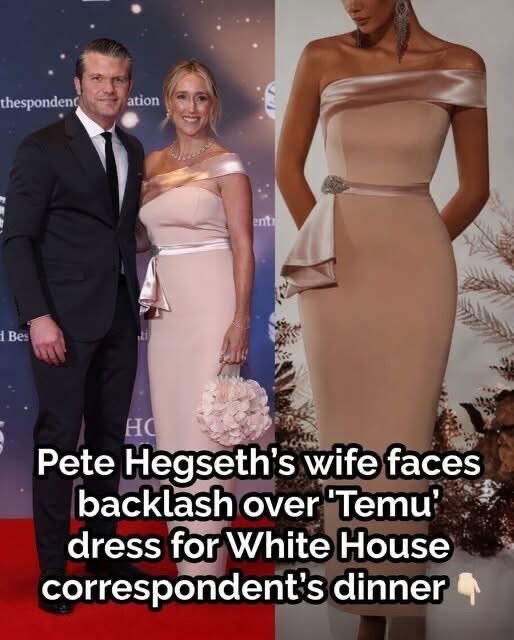
Nonetheless, as the circumstance normalized and the hazard was dispelled, the climate reverted to a tense regularity, permitting the assemblage to recommence their dusk. It was subsequently that an entirely distinct sort of account captured the electronic world, one far more commonplace but far more divisive than a protection hazard. Photographs of Jennifer Rauchet commenced moving on diverse social interaction networks, and consumers rapidly observed her graceful but seemingly modest attire. The attire, a garment that captured the vision of numerous individuals, showcased cascading elements that many would connect with haute couture, yet the cost indicator and the merchant’s catalogue narrated a completely diverse account. What commenced as informal appreciation quickly erupted when a keen-sighted consumer asserted that her gown closely mirrored a low-price, economical piece vended on the multinational merchandising network Temu.
Virtually instantaneously, a side-by-side analogy of the gown went viral, transforming the basic garment selection into a massive societal flashpoint. The internet, faithful to its erratic essence, grabbed this exposure and generated a turbulent dispute that completely eclipsed the grave occurrences of the earlier dusk. Detractors of the apparel contended that donning such a pocket-friendly or low-price gown at an occasion of this scale clashed intensely with the conventional anticipations of prestige, affluence, and delivery connected with the Washington aristocracy. Some commentators even endeavored to couple the style selection to broader governmental messaging, querying whether an economical apparel corresponded correctly with the traditional American First principles advocated by many in the chamber.
Conversely, advocates of Jennifer Rauchet resisted just as forcefully against the detraction. They highlighted that economical style is incredibly widespread in the contemporary epoch and contended that forming an assessment based on the cost tag of a piece of clothing is completely disconnected from the actuality of everyday citizens. They lauded her choice to don what she fancied, irrespective of its creator brand or expense, contending that an individual’s merit and grace should not be shackled to an exorbitant cost tag. This outlook emphasized an escalating bitterness toward the radical affluence and prodigality frequently exhibited at aristocratic Washington banquets, framing her apparel as a stroke of sensible brilliance rather than a style blunder.
The succeeding dispute rapidly broadened far past Rauchet herself and the specific gown she wore. It rekindled fierce deliberations encompassing the morality of rapid fashion, the availability of fashionable garments for the general populace, and the immense duress applied to civic figures to project an impression of extreme affluence. What commenced as a minor inquiry regarding an evening gown altered into a much broader dialogue concerning socioeconomic strata dynamics, societal emblems, and the manner the populace views their chieftains and proxies. Examiners and style chroniclers contributed opinions, remarking that garments have permanently been a primary medium for political and societal communication across history.
The synchronization of the occasion magnified the fierceness of the dispute tenfold. The stark variance between a grave, potentially perilous protection occurrence and a minor style dispute highlighted precisely how rapidly civic focus can shift in the contemporary media terrain. In today’s electronic era, a solitary picture or a solitary post can re-route the nationwide focus within a span of minutes, turning a grave political occurrence into a viral internet marvel that hooks millions of consumers across the sphere.
In the finale, the viral instance was never truly regarding the gown itself. It was regarding what diverse individuals perceived when they gazed at the apparel. For some, it embodied a paradox in prestige, while for others, it was a breath of fresh atmosphere and an emblem of approachability. Ultimately, the fierce feedback voices far more regarding the spectators and the split essence of our societal dialogue than it executes regarding the apparel. It endures as a potent token of how the contemporary populace communicates with the existences of those in the civic eye, perpetually foraging for significance and disputation in the most ordinary of localities.
