Donald Trump Jr. and Bettina Anderson’s Private Wedding Draws Attention Over Notable Absences
A Quiet Ceremony Far From the Spotlight
Donald Trump Jr. and Bettina Anderson chose an intimate setting for their wedding, exchanging vows during a private ceremony on a secluded island in the Bahamas.
Unlike many high-profile family celebrations that attract extensive public attention, this event was intentionally small. The guest list remained limited, creating an atmosphere centered on privacy rather than spectacle.
Even so, the wedding quickly became a topic of widespread discussion. The focus shifted away from the ceremony itself and toward the people who were not present.
As news of the wedding spread, public curiosity grew over several notable absences. Conversations surrounding the event soon centered on family dynamics rather than the celebration of the marriage.
Attention Turns to Family Members Who Were Missing
Among the most discussed absences was that of Donald Trump. His decision not to attend the ceremony immediately sparked questions and speculation.
While he publicly expressed support and offered well wishes to the newly married couple, many observers remained focused on the fact that he was not physically present at the event.
For some, the absence appeared unusual given the significance of the occasion. Weddings often serve as major family gatherings, making any missing family member especially noticeable.
As a result, public discussion quickly expanded beyond the wedding itself. The narrative became less about the ceremony and more about what the empty seat might represent.
In the absence of detailed explanations, speculation naturally filled the space. Various interpretations emerged, each attempting to explain why one of the most recognizable members of the family did not attend.
Questions Grow Following Another Reported Absence
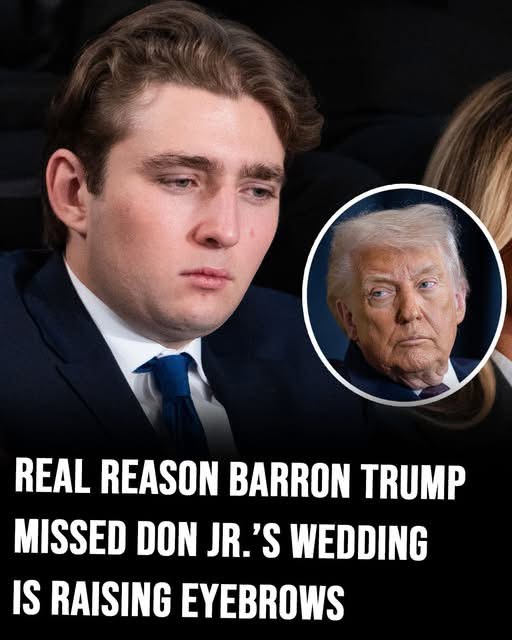
The attention intensified further when reports indicated that Barron Trump was also not present at the ceremony.
His reported absence introduced another layer to the ongoing conversation. Observers began examining family relationships and searching for deeper meaning behind who attended and who did not.
The discussion expanded beyond logistics and entered the realm of interpretation. Commentators and online audiences began drawing connections between family history, age differences, and public perceptions.
sSome viewed the situation as evidence of possible divisions. Others saw it as an example of how ordinary scheduling conflicts can become amplified when they involve a family constantly under public scrutiny.
Regardless of perspective, the absence generated renewed interest in relationships among family members whose lives have been followed closely for years.
