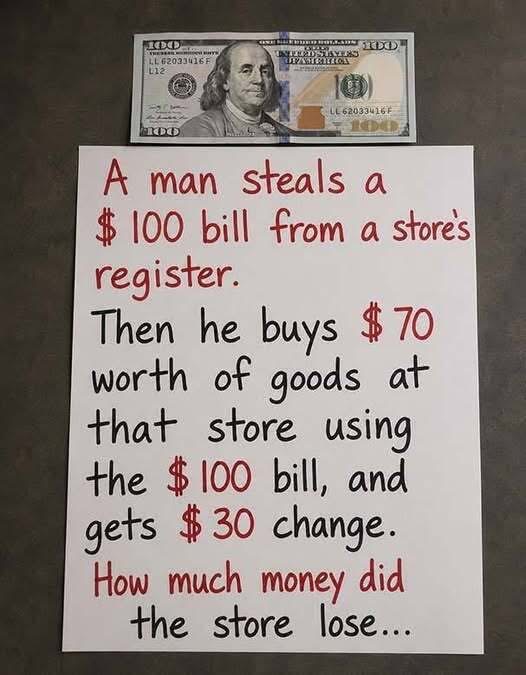
At first glance, the riddle seems incredibly easy. Most people immediately assume they know the answer within seconds. But the more they think about it, the more confusing it becomes. That’s why this simple problem has sparked endless online debates, with people confidently arguing for completely different answers.
Here’s the setup:
A man steals a $100 bill from a store register. Later, he returns to the same store and uses that stolen $100 bill to buy $70 worth of merchandise. The cashier then gives him $30 in change.
sSo how much did the store actually lose?
Many people quickly answer $200 because they count both the stolen money and the merchandise separately. Others say $170 or $130 after trying to calculate every step individually. But the trick is realizing the original $100 bill eventually returns to the register during the purchase.
In the end, the store still has the same $100 bill back in the cash drawer. What’s permanently gone is:
$70 worth of products
$30 in cash change
That equals a total loss of exactly $100.
Another way to picture it makes the answer clearer. Imagine the thief simply walked into the store and demanded:
$70 worth of merchandise
$30 cash
Without ever mentioning the stolen bill.
The store would obviously lose $100 total. The confusion only happens because people accidentally count the same $100 bill twice — once when it’s stolen and again when it’s used to make the purchase.
That’s what makes riddles like this so addictive. They test careful reasoning more than difficult math. The wording tricks your brain into overcomplicating something simple.
So no matter how many times you recalculate it, the answer remains the same:
✅ The store lost exactly $100.
