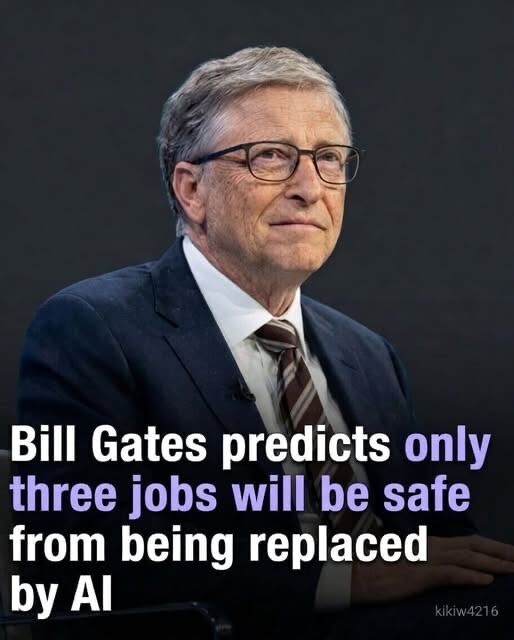
As artificial intelligence (AI) continues to evolve, its impact on the future of work is becoming more apparent. Technology leaders, including Bill Gates, have suggested that AI could eventually handle many tasks currently performed by humans, reshaping industries and transforming how jobs are done. While some roles may become less relevant over time, others will likely evolve, requiring individuals to adapt to new ways of working alongside AI systems.
Gates has highlighted how expertise in fields like medicine or education has traditionally been valued due to its limited accessibility. However, as AI tools improve, access to high-quality information and expert guidance could become more widespread. Tasks that once required years of training may become easier to perform with the assistance of AI, which could democratize knowledge and reduce barriers in sectors like education and healthcare. This shift is referred to by Gates as the rise of “free intelligence,” where advanced knowledge is made more accessible through technology. While this brings exciting possibilities, it also raises questions and challenges for industries and workers adjusting to the rapid pace of change. As AI becomes integrated into various processes, it will influence decision-making and service delivery across many sectors. Rather than replacing humans entirely, the future of work is likely to involve collaboration between people and technology. Human qualities such as creativity, empathy, and critical thinking remain essential. By focusing on adaptability and continuous learning, individuals can remain valuable contributors in a technology-driven world, where AI enhances human capabilities rather than replacing them.
Bill Gates, in recent interviews and his annual letters, has been remarkably candid about the seismic shifts AI is bringing to the global workforce. He points out that AI will act as a powerful equalizer, making expert-level knowledge available to anyone with a smartphone or basic computer. In medicine, for instance, AI systems can already analyze scans, suggest diagnoses, and even draft treatment plans with accuracy rivaling top specialists. Yet Gates stresses that the doctors who will thrive are those who combine AI insights with genuine patient empathy, ethical judgment, and the ability to communicate complex decisions in human terms. A radiologist using AI might review hundreds of cases per day instead of dozens, but the irreplaceable value lies in interpreting results within the full context of a patient’s life story, fears, and family dynamics—areas where machines still fall short.
In education, the transformation could be even more profound. Gates envisions AI tutors providing personalized lessons tailored to each student’s pace and learning style, potentially closing achievement gaps that have persisted for generations. However, the teachers who will flourish in this new era are not those who simply deliver information but those who inspire, mentor, and foster creativity and social skills. They will design experiences that AI cannot replicate: facilitating group debates that build emotional intelligence, guiding hands-on projects that spark innovation, and offering the motivational support that keeps students engaged through challenges. Gates has repeatedly said that “free intelligence” will amplify human potential, but only if people lean into uniquely human strengths like curiosity, collaboration, and moral reasoning.
The business world is already feeling these changes acutely. Roles in data analysis, basic coding, legal document review, and routine customer service are rapidly being augmented or automated. Yet Gates predicts a surge in demand for professionals who can orchestrate AI systems, interpret their outputs, and apply them creatively to solve real-world problems. Careers in AI ethics, human-AI interface design, and sustainable technology development are poised for explosive growth. He emphasizes that adaptability will be the most critical skill of the next decade—workers must commit to lifelong learning, regularly updating their knowledge as tools evolve. Those who resist change risk being left behind, while those who embrace it as partners with AI will discover new opportunities that were unimaginable just a few years ago.
Healthcare stands out as one of the most promising sectors for resilient careers. Beyond doctors and nurses, Gates highlights roles in mental health support, physical therapy, caregiving for aging populations, and personalized wellness coaching. AI can monitor vital signs 24/7 and flag potential issues early, but the healing touch, emotional presence, and nuanced understanding of human suffering remain profoundly human. Similarly, in creative industries—writing, design, music, and entertainment—AI tools can generate drafts, suggest variations, and handle repetitive tasks, freeing artists to focus on originality, storytelling depth, and cultural resonance that machines cannot authentically produce. Gates notes that entertainment and media professionals who learn to direct AI as a creative collaborator rather than fear it as competition will lead the next wave of innovation.
